
The choice of first loom has a direct effect on what a new weaver can produce and how quickly they progress. Three loom categories dominate the Canadian hobbyist market: frame looms, rigid heddle looms, and floor looms. Each has a distinct mechanical logic, a different price range, and a different ceiling in terms of what it can produce.
This article lays out those differences without pushing any particular direction. The right choice depends on the kind of fabric you want to make, the space you have available, and the budget you can commit at the outset.
Frame Looms
A frame loom is the simplest structure in common use. It consists of a rigid rectangular frame — usually wood — with pegs, notches, or nails at fixed intervals along opposite edges. The warp threads are strung between these anchor points, and the weaver passes weft thread over and under using their fingers, a blunt needle, or a small shuttle.
Frame looms are available in sizes ranging from a few centimetres across (suited to tapestry samples and small weavings) to approximately 60 cm wide (capable of producing scarves and wall panels). Prices in Canada typically range from $30 to $150 CAD depending on size and construction quality.
The main limitation of frame looms is the absence of a shedding mechanism. Every row requires manually separating warp threads. This makes larger or more complex pieces slow to produce. Frame looms work well for tapestry-style pictorial weaving, where deliberate pace is part of the process, but are not suited for producing lengths of fabric efficiently.
Rigid Heddle Looms
The rigid heddle loom introduces a shedding device — the heddle itself — which simultaneously separates warp threads into two groups and carries a reed for beating the weft into place. Pushing the heddle up creates one shed; pushing it down creates the other. This halves the physical motion required for plain weave compared to working on a frame loom.
Rigid heddle looms are produced at widths between roughly 20 cm and 60 cm, with 40 cm being a common choice for scarves and 60 cm opening options for table runners, small placemats, and wider cloth. Canadian pricing ranges from approximately $200 to $600 CAD for quality models from manufacturers such as Schacht, Ashford, and Halcyon Yarn.
The heddle's slot-and-hole design determines the sett (threads per centimetre) you can weave. Most rigid heddle looms accept interchangeable heddles at different dents — typically 5, 7.5, 10, and 12.5 dents per centimetre — giving flexibility across yarn weights from bulky to fine.
With pick-up sticks, a rigid heddle loom can produce simple twill patterns, lace weaves, and basic colour effects, though it cannot replicate the full range of structures available on multi-shaft floor looms.
Floor Looms
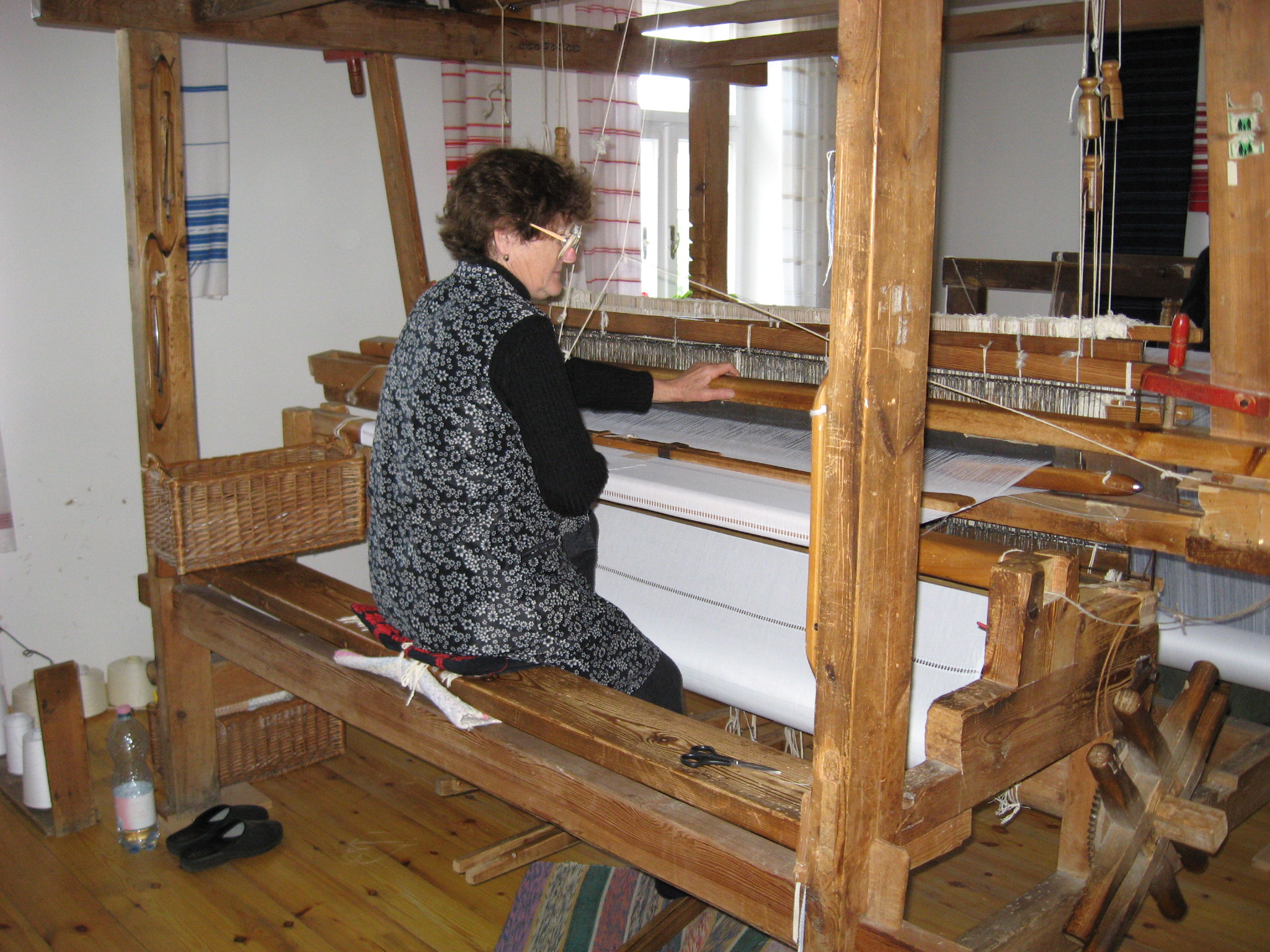
A floor loom uses multiple shafts (also called frames or harnesses) — typically four or eight — each carrying a set of heddles through which warp threads are threaded individually. Pressing treadles with the feet raises or lowers selected shafts, creating a wide range of sheds. This is what makes twill, satin, overshot, and complex pattern weaving possible.
Floor looms are available in both countermarch and counterbalance designs. A four-shaft countermarch loom from Louet or Schacht typically costs between $2,500 and $5,000 CAD new, with used market prices ranging from $800 to $2,500 depending on condition and provenance. An eight-shaft loom adds capacity for more complex threading at considerably higher cost.
The weaving width on floor looms commonly runs from 60 cm to 120 cm, making them suitable for cloth production — enough width to weave fabric for clothing, blankets, or yardage. The loom requires a dedicated floor area: a four-shaft 90 cm floor loom typically occupies roughly 120 cm×130 cm of floor space, plus working clearance in front and behind.
A Practical Comparison
- Frame loom: $30–$150 CAD, no dedicated space required, suited to tapestry and small weavings, no shedding mechanism.
- Rigid heddle loom: $200–$600 CAD, desktop or lap use, suited to scarves and lightweight fabric, single-shaft shedding with pattern possibilities via pick-up sticks.
- Floor loom: $800–$5,000+ CAD, dedicated room required, suited to fabric production and complex weave structures, four or more shafts.
Most weavers who become serious about the craft eventually move through these categories in order, though some stay with rigid heddle work indefinitely — the loom is capable enough to produce high-quality cloth for many purposes, and its portability remains an advantage even for experienced weavers.
Second-Hand Looms in Canada
The used loom market in Canada is active. Regional guild networks, Kijiji listings, and estate sales regularly surface Leclerc, Nilus, and older Schacht equipment at significant discounts. A Leclerc four-shaft floor loom in good condition can be acquired for $600–$1,200 CAD — roughly a third of new pricing. Condition assessment requires checking the reed, heddles, and tie-up cords, all of which can be replaced without difficulty.
For further reading on loom mechanics, Handweaving.net maintains a large archive of threading and tieup drafts organized by weave structure, useful for understanding what different looms can produce before committing to a purchase.